Professional Divers
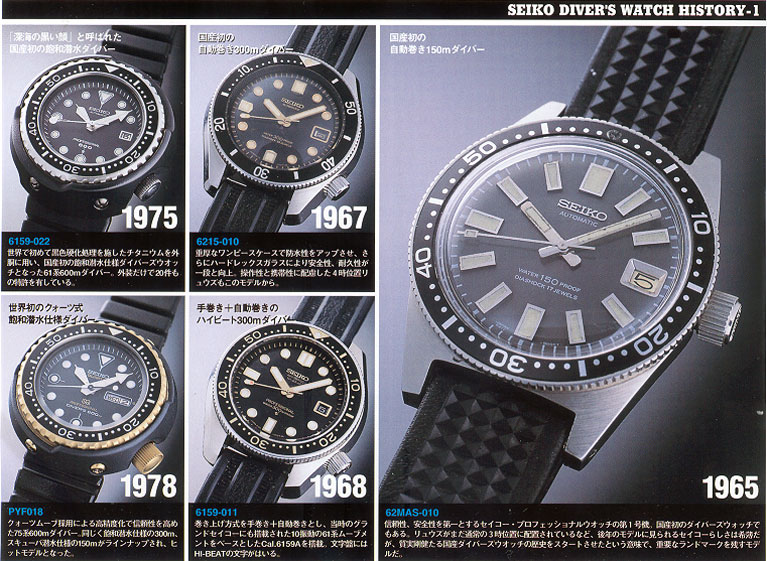
The Seiko Professional Divers are watches specifically designed for saturation diving where high water-resistance level, durability, and ability to withstand extreme environmental conditions are basic use requirements. They are the top-tier watches that exemplify the best design and engineering Seiko offers in their sports line-up. Historically, these models were designed for and worn by professional divers, expedition teams, and explorers popular in the 1960s to 1990s.
Below are representative models of professional divers that illustrate Seiko's design and engineering efforts to solve particular problems at the time. This list is by no means exhaustive, and the reader is encouraged to visit the many useful resources on the net that cover any of these or other divers in much greater depth.
Models
- 6215-010 (6215-7000) 300m Diver (released in 1967)
- 6159-010 (6159-7000) 300m Diver (released in 1968)
- 6159-022 (6159-7010) 600m Professional Diver (released in 1975)
- The Professional Diver's 600m 7549-7000 (released in 1978)
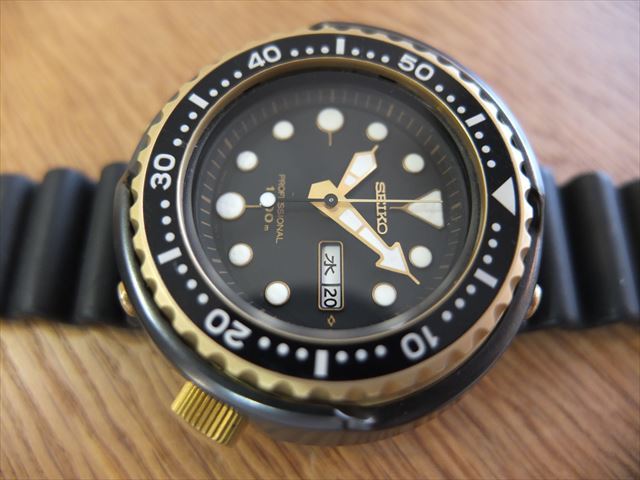
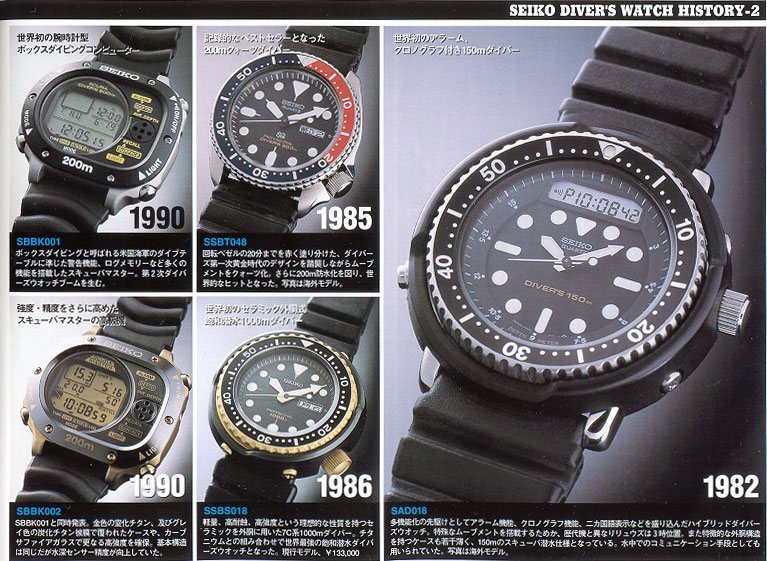
- SSBS018 7C46-7009/7010 1000m Professional Diver (released in 1986)
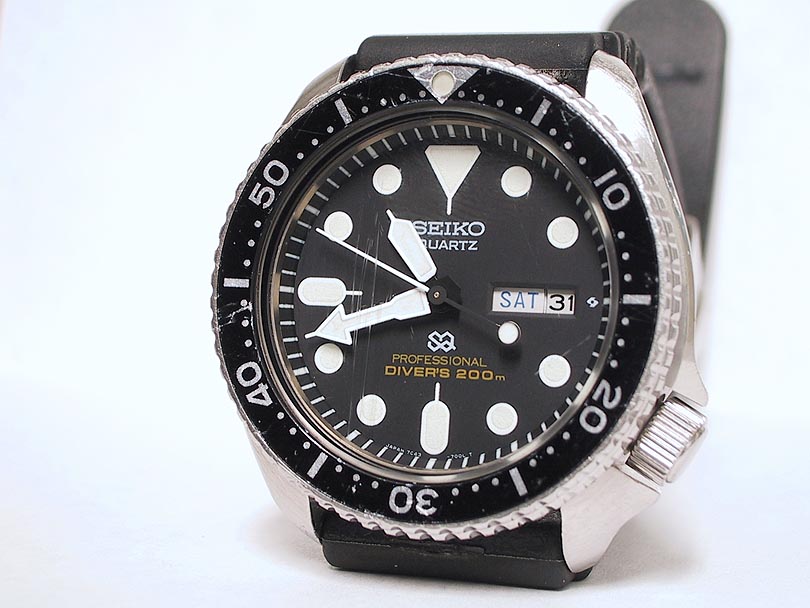
- 7C43 200M Quartz Professional Diver (released in 1986)
Details
6215-010 (6215-7000) 300m Diver
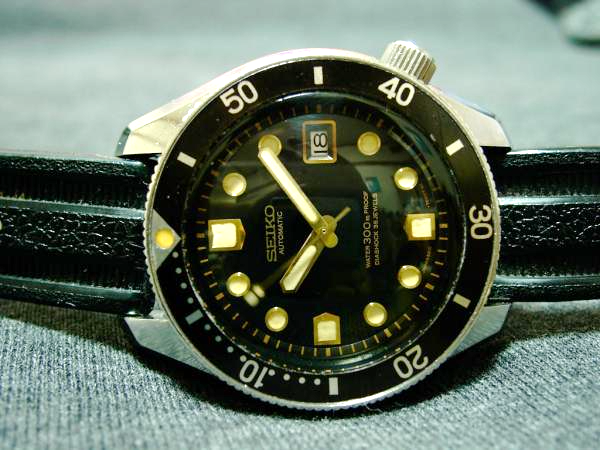
Credit: Seiko & Citizens Watches Forum contribution
Year released: 1967
This diver marks Seiko's entry into designing a full-fledge professional diving watch specially engineered for heavy-duty use. The watch is rated to 300m of water resistance and housed in a monocoque case to reduce the possibility of water ingress. It uses a Hardlex mineral crystal that will become ubiquitous among Seiko watches since then, and as a new feature of divers in this period, the watch bezel uses a click ball for bezel alignment and therefore the rotation is bi-directional. The movement is the 35J cal. 6215A, which beats at 19,800bph.
The 6215 300m diver first appears in the Seiko JDM catalog supplement No. 2 with the following listed features:
- Automatic movement
- Date calendar
- 300m waterproof (resistance)
- Hardlex crystal
- Lume
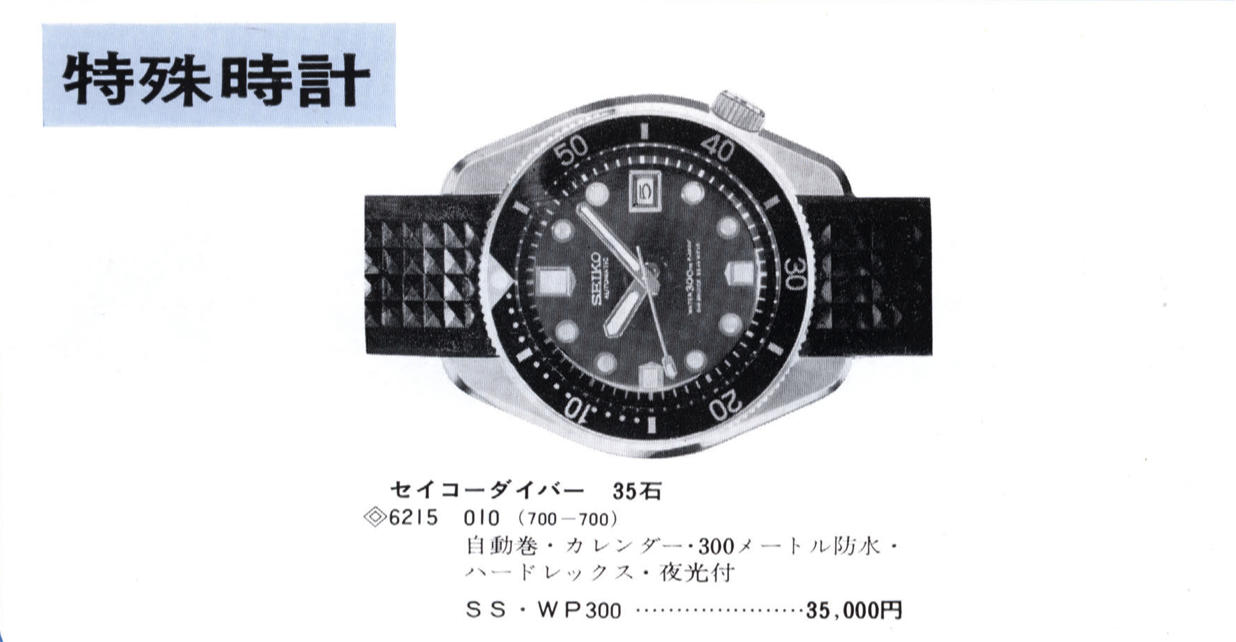
Credit: 1967 Seiko JDM Catalog No. 2 Supplement (from plus9time.com)
It's interesting to note that when Seiko was working on the 6215 diver, much of the knowledge about how to engineer professional dive watches did not exist as this was a new area Seiko's development team had not worked on before. But the market pressure was evident as Swiss companies like Rolex, Blancpain, Doxa, as well as every other smaller European watchmakers had been actively developing and releasing diving watches to cater to the demands of professional divers, underwater sports enthusiasts, and adventurers. So the pressure was very much there for Seiko to compete with the Swiss by developing their own line of high-performance professional diving watches.
Akio Nishizawa, the case design engineer for the 6215 diver, gives this account of the development process: "I was in charge of this model in the 5th year after joining the company. In designing, I had little knowledge of the design of waterproof watches, and the development of waterproof structures was not very advanced yet...." As Nishizawa completes the structural design of the diver, he recalls how, "in the inspection of the waterproof performance of the prototype, a small tubular vertical waterproof tester made in a foreign country [i.e., most likely Switzerland], was used. I was unable to fully test the barometric pressure, and maybe the tester will explode if I apply a level of 30 barometric pressure" (The Seiko Professional Diver's Watch, Sadao Ryugo, 2002, p. 56).
The 6215 diver was released soon after the 62MAS and was Seiko's entry to compete with Rolex and to surpass them. The features listed with the watch in the 1967 Supplement are a glimpse of the technology Seiko will continue to refine over the years. These include the monocoque case for professional divers, the synthetic Hardlex mineral crystal still in use today, use of a screw ring to secure the crystal and rubber gasket -- or "packing" as it is called, a technique that they will later refine into the "L-packing" helium-proof feature in the Tuna divers -- and Seiko's own version of the screw-down and recessed crown, moved from the 3 o'clock position to 4 o'clock, with part of the case serving as a crown guard.
Seiko divers and even non-sports models were used and field tested by professionals and reseachers, as Seiko was active in the development of instrumentation and precision devices for scientific and other uses. When the 62MAS diver was released earlier in 1967, Seiko had donated 30 units of the watch to the 8th Japanese Antarctic Research Expedition (JARE8). For the 9th Japanese Antarctic Research Expedition (JARE9) in 1968, Seiko donated 78 watches selected among 6 varieties (including the Business Bell, World Time, and the 6105 divers). Four units of the 6215 divers were given to the research team to assist them in doing underwater biological survey work. (See The Seiko Professional Diver's Watch, Sadao Ryugo, 2002, pp. 39-46.)
6159-010 (6159-7000) 300m Diver
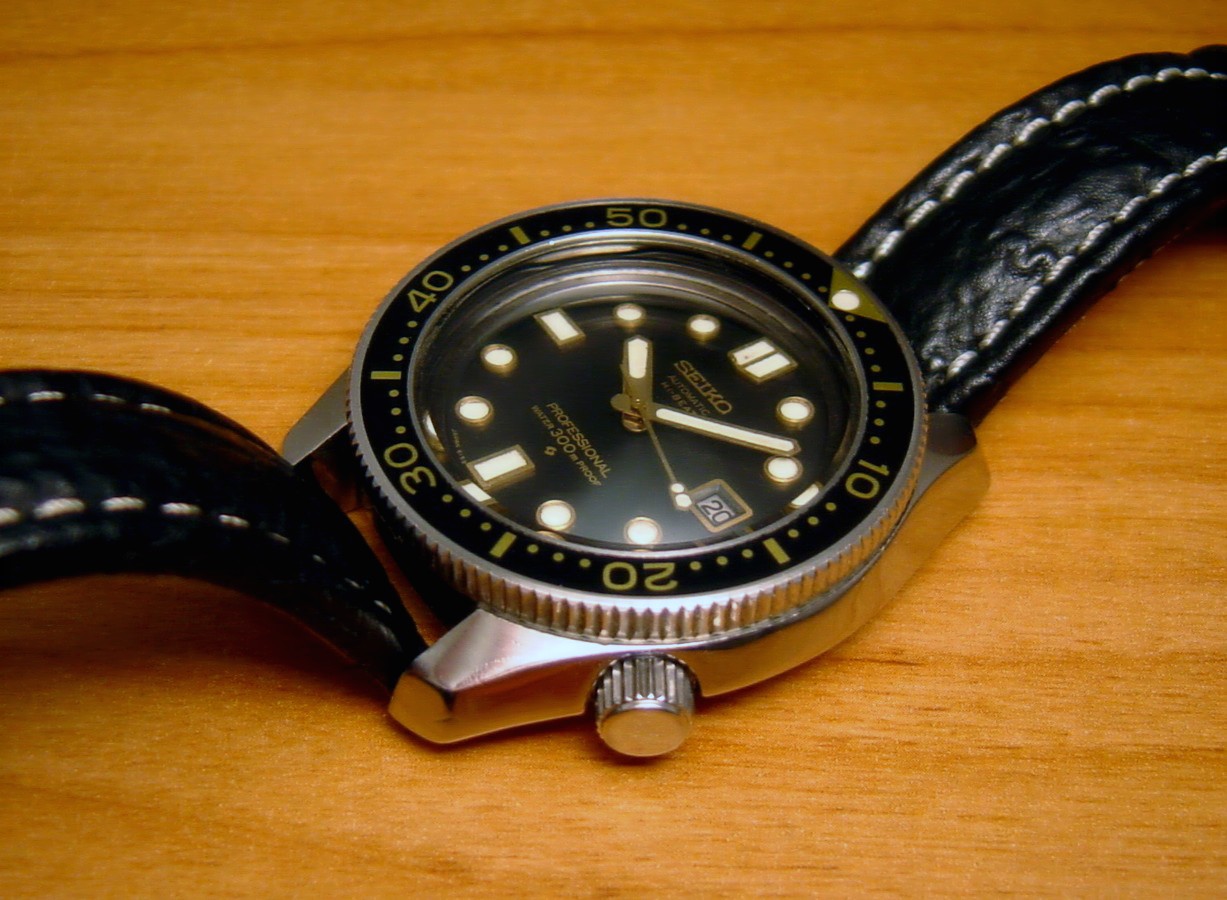
Credit: Chris Moy
Year released: 1968
Seiko's internal mandate at this point was to create a professional diving watch that would compete with Rolex, and the development team was empowered to do as much as they could to surpass their European competitor. The 6159-7000 300m diver was their first attempt.
The 6159-7000 diver uses a high-beat cal. 6159A movement that is on the same level as the Grand Seiko's at that time -- the 6145 and 6146. The movement was used to ensure precision and high performance in the field. It has 25J, with a frequency of 36,000bph -- 10 beats a second -- can be hacked, and is hand-windable. The diver inherited the monocoque case and depth rating of its predecessor, the 6215, as 300m was a rating that, even though it might have been overkill for recreational and scuba use, portrayed Seiko as a serious competitor in the horological world capable of pushing the limits of their engineering ability.
The 6159-7000 diver first appears in the 1968 Seiko JDM catalog No. 2 with the following features:
- Automatic movement, hackable
- Hardlex crystal
- Lume
- 300m waterproof (resistance)
- 10 beats/second
- Diver's rotating bezel
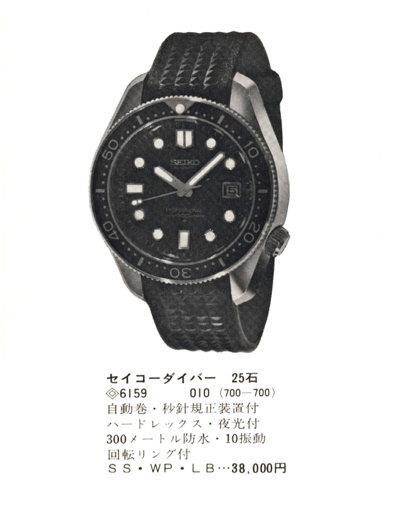
Credit: 1968 Seiko JDM Catalog No. 2 (from plus9time.com)
The first variant of the 6159 diver (6159-7000) was replaced by the 6159-7001 with essentially identical specs. Initially, the 6159-7000 diver has a dial that is marked "WATER PROOF." Later, in August 1969, the dial marking in the 6159-7001 diver was changed to "WATER RESIST" in order to comply with water-resistance standards at the time.
In 1970, as part of "The Japanese Mount Everest Expedition 1970 (JMEE '70)," explorers Naomi Uemura and Teruo Matsuura of the Japanese Alpine Club reach the South Peak of Mt. Everest. Both climbers use the Seiko 6159-011 (6159-7001) diver as part of their climbing equipment.
6159-022 (6159-7010) 600m Diver
Credit: auctions.yahoo.co.jp
Year released: 1975
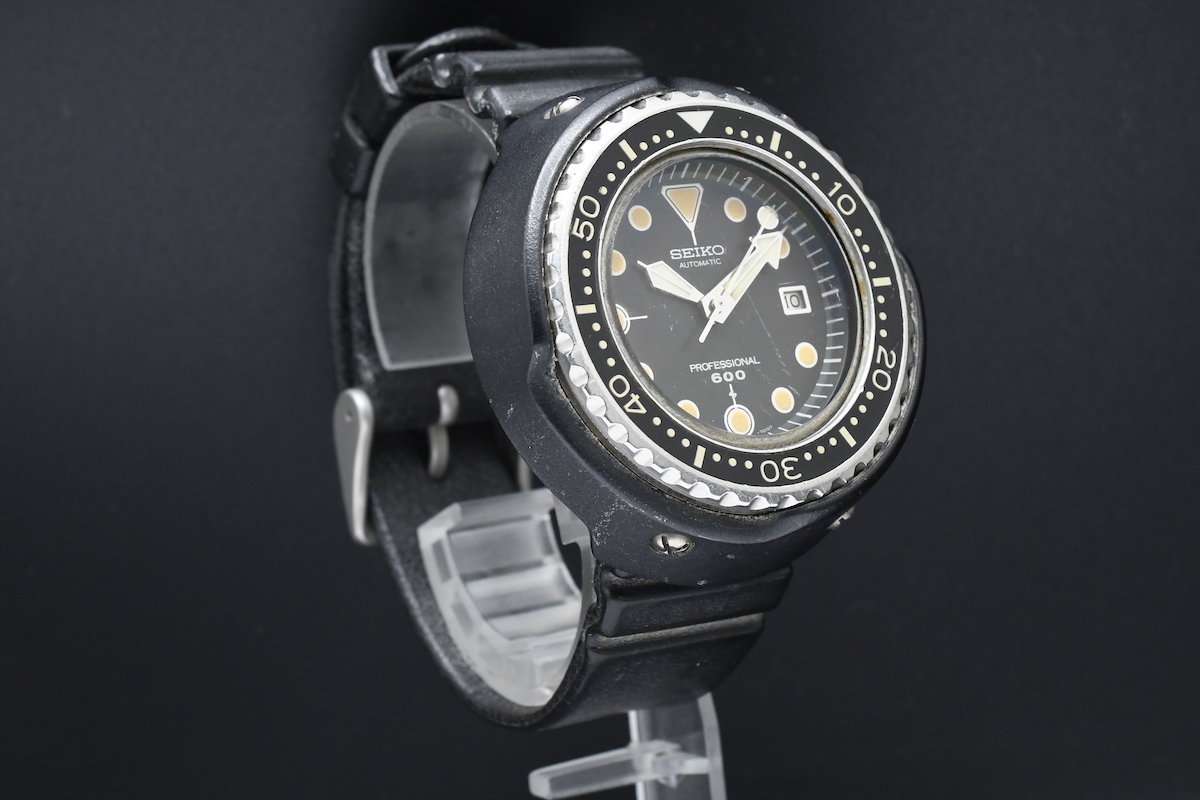
The 6159-7010 600m diver is the world's first professional 600m diving watch in a titanium case. The design of this diver is unique and has earned the popular name of "Tuna" because of its large and thick case (50mm in diameter). Because it's the first of its kind, this diver is referred to as the "Grandfather Tuna."
Titanium was used for its corrosion-resistant properties and the unique case design resembles a barnacle, as Mr. Ikuo Tokunaga, the chief design engineer of many of Seiko's divers, explains. The idea is to encase the watch in a shroud to protect it from shock and abrasion.
The large case uses what Mr. Tokunaga calls the "L-packing" technique that employs a screw ring to secure the L-shape gasket between the crystal and front opening of the monocoque case. The gasket used a new formulation of butyl rubber, which improves the seal over the traditional nitrile rubber used before. This mechanism works to prevent helium molecules from ingress and egress so the watch is "practically impermeable to helium gas" and does not require an escape value.
With the release of this diver Seiko also pioneered the design of the accordion rubber strap that allows it to shrink and stretch as it's worn on a wetsuit under changing pressure. Seiko has earned 20 patents for the innovative design of this diver. (See "Sports Watches That Go To Extremes," A Journey in Time, Seiko Watch Corporation, 2003.)
Inside the 6159-7010 diver is the 25J high-beat cal. 6159B movement, beating at a frequency of 36,000bph and improved over the previous variant of cal. 6159A. The cal. 6159B movement, while based on the 6159A and similar to the Grand Seiko's cal. 61 movements, is constructed of different components to make it more stable and reliable under stress.
The 6159-7010 diver is very much a showcase of the best of the best Seiko has to offer in horology, industrial design, material science, and engineering.
The 6159 is listed in the 1975 Seiko JDM Dealer's Catalog Vol. 1 as "Seiko Diver Professional" with the following features:
- Automatic movement, hackable
- 600m water resistance
- Diver's elapsed time rotating bezel
- Lume
- High beat
- Hardlex crystal
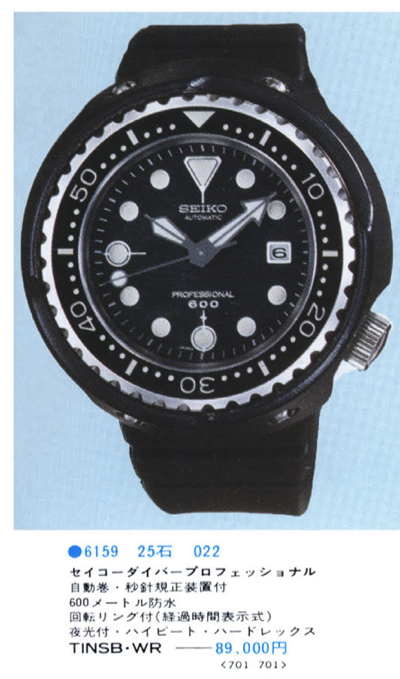
Credit: 1975 Seiko JDM Dealer Catalog Vol. 1 (from plus9time.com)
How the diver's design came about stems from the now well-publicized story of a complaint letter Seiko received. In 1968, Seiko received a letter from Hiroshi Oshima, who worked as a professional saturation diver for the Nippon Marine Industry Co. (later to become Sumitomo Marine Development Co.). Mr. Oshima explained that his work involved using a deep sea diving capsule at depths of 350m. When performing decompression as part of saturation diving protocol, the Seiko 300m diver was "unusable."
This was a shock to Taro Tanaka, who pioneered the "Grammar of Design" and served as the chief designer of many of Seiko's iconic timepieces, including the professional divers.
Mr. Tanaka undertook the challenge of studying the environment in which professional saturation divers needed to work -- oil drilling platform, deep-sea diving capsules, decompression chambers, etc. -- and formed a development team to improve the diving watch specifically to address the shortcomings of its previous designs and to meet the requirements of this professional extreme use case.
Seiko spent the next 7 years, from 1968 to 1975, working on the new design and engineering of the next diver, and the 6159-7010 is the result. (The Seiko Professional Diver's Watch, Sadao Ryugo, 2002, pp. 121ff).
Also see: The History of Seiko Diver's Watches @ seikowatches.com
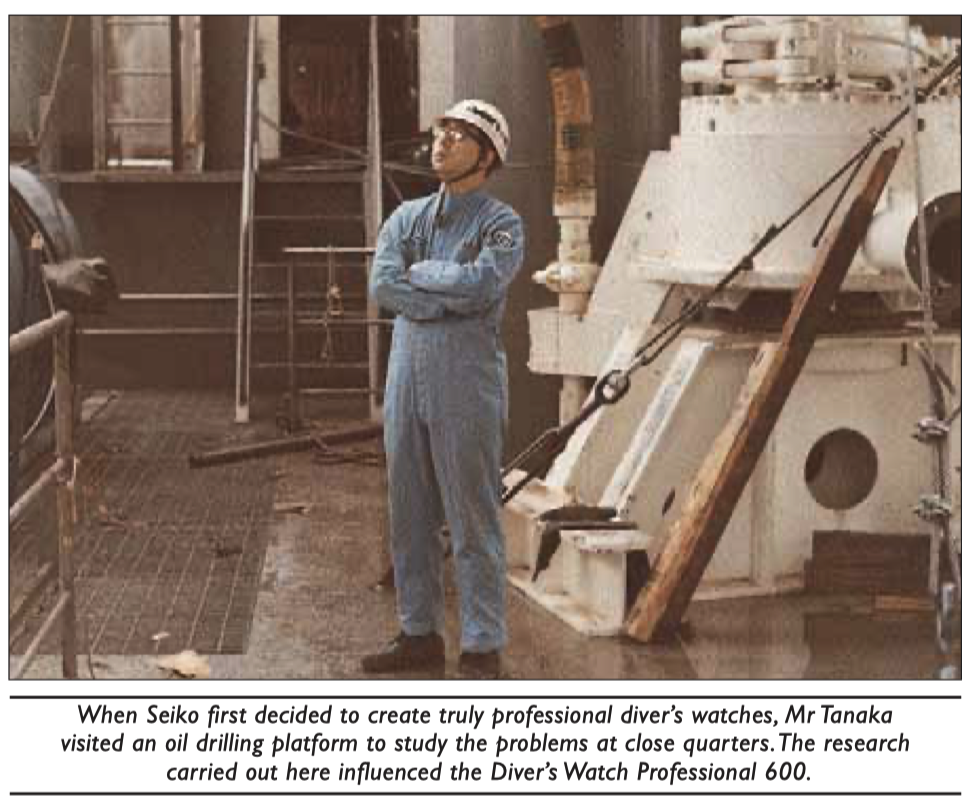
Credit: A Journey in Time (by Seiko)
The Professional Diver's 600m 7549-7000
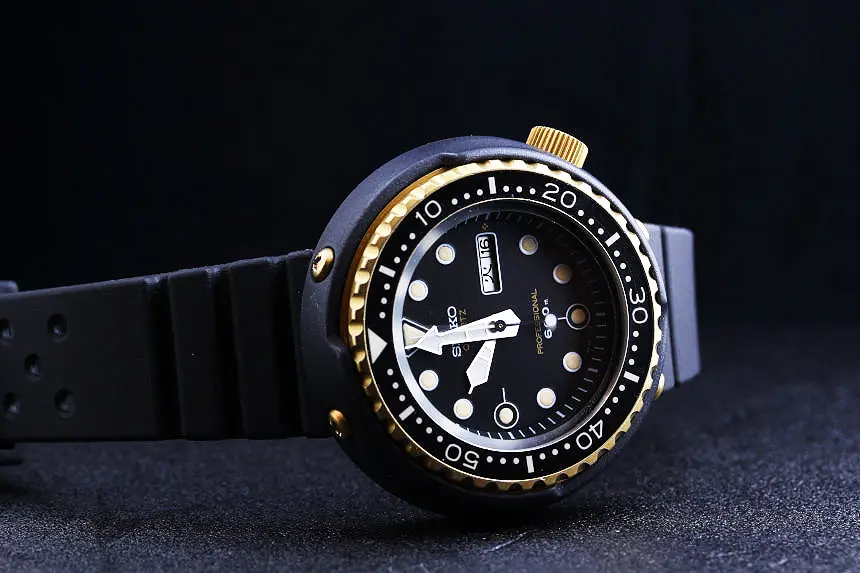
Credit: tokei.blog
Year released: 1978
Three years after the 6159-7010 600m Professional Diver's watch, Seiko will release a new iteration of the "Tuna" design, this time using a quartz movement, the cal. 7549A. The 7549-7000 (model PYF018) was the world's first saturation diving watch using a quartz movement. The case is again made of specially-coated titanium (using titanium nitride plating) for scratch resistance and features a gold color bezel, hence its nickname as the "Golden Tuna." An international version of the watch is marketed with the model code 7549-7009.
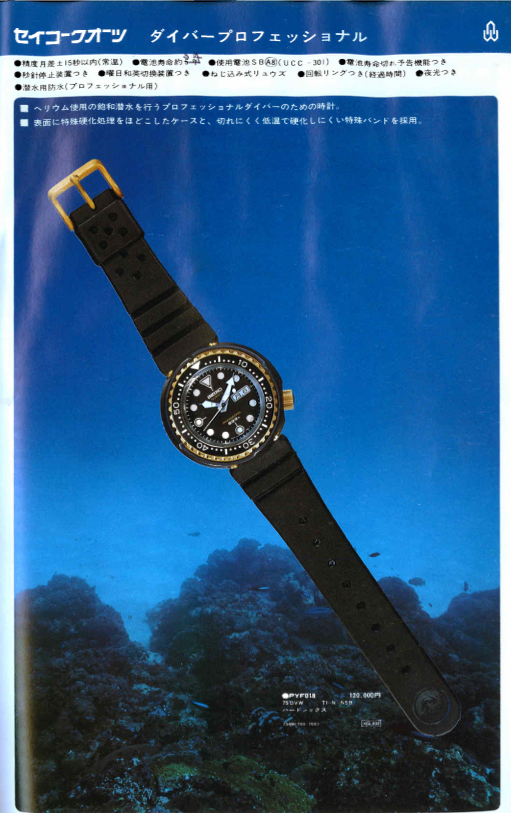
The 7549-7000 "Diver Professional" is listed in the 1978 Seiko Catalog V2 with the following features:
- Accuracy to 15 secs/month
- Battery life: 5 years
- Battery: SB A8 (UCC-301)
- Low battery warning indicator (second hand will jump at 2-second intervals)
- Hacking
- Japanese/English day of the week indicator
- Screw-down crown
- Diver's elapsed time rotating bezel
- Lume
- Water resistance suitable for professional use
- Designed for professional saturation diving
- Scratch resistant case surface treatment
- Cut-resistant specialized strap for use in low temperature
In 1983, a reliability test of the 7549-7000 Professional Diver's 600m watch was undertaken where the diving watch was strapped to the JAMSTEC (Japan Agency for Marine-Earth Science and Technology) "Shinkai 2000" research submersible and taken to a depth of 1,062 meters below sea level. The watch performed without a glitch and successfully survived the descent that is nearly twice as deep as its rated maximum limit.
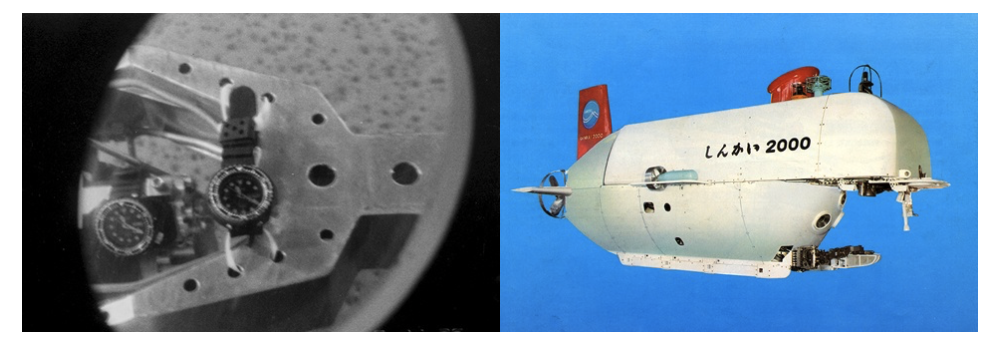
Credit: JAMSTEC/seikowatches.com
A 7549-7009 Professional Diver appears in the 1981 James Bond film, "For Your Eyes Only." The watch is visible on Roger Moore's wrist as he wears it over his yellow diving suit, though there are no close-ups shots of the diver in the film.
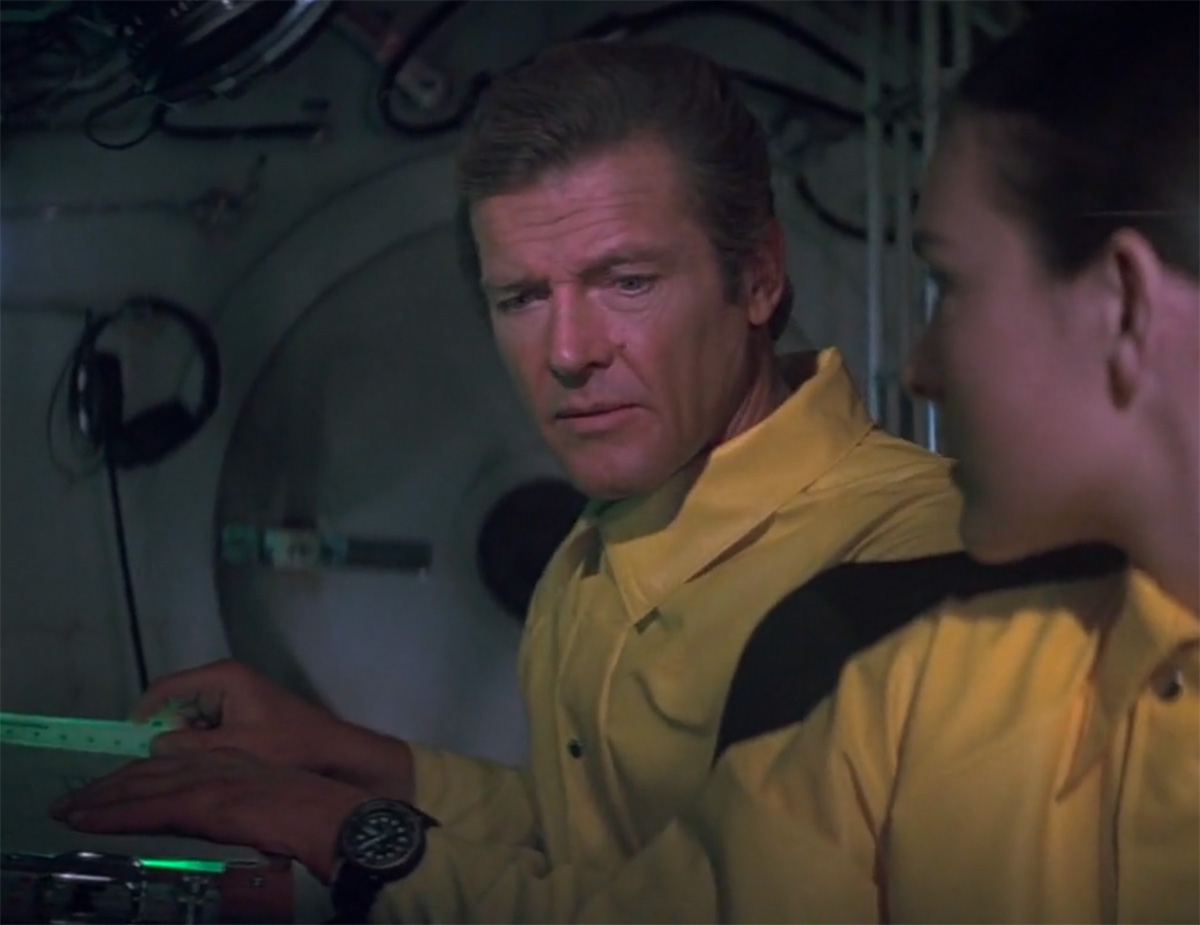
Credit: jamebondlifestyle.com
SSBS018 7C46-7009/7010 1000m Professional Diver
Credit: ameblo.jp
Year released: 1986
Technical Manuals
The Tuna diver will get a new iteration in 1986 with the 1000m SSBS018 (7C46-7009/7010). The "Professional Diver's 1000M" is the first watch to use ceramic-coating over titanium for the outer case. The depth rating was bumped up to 1000m. The cal. 7C46 movement is Seiko's customize quartz movement used for their line of professional divers and is designed as a high torque and highly efficient, low-current consumption movement for powering the drivetrain of heavy-duty divers.
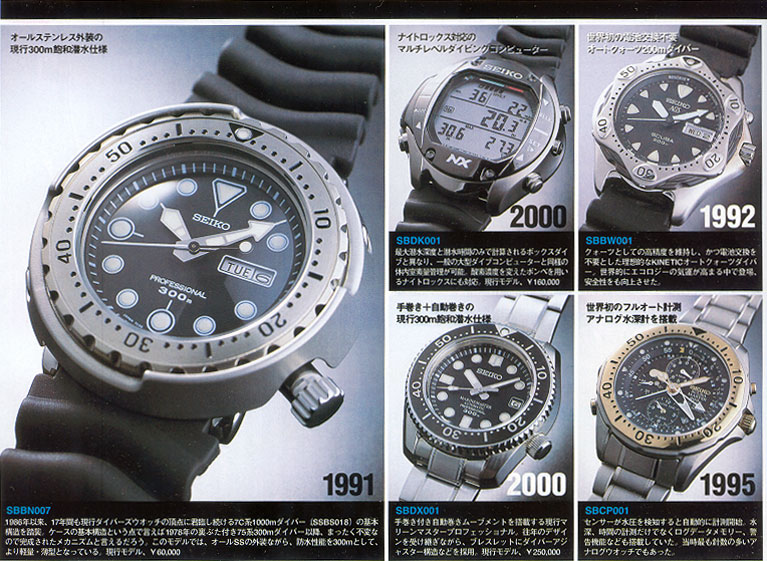
Seiko will return again and again to this and previous generations of the Professional "Tuna" divers and iterate on them as reissues and commemorative editions. For obvious reasons, the Tuna line of professional saturation divers is one of the most, if not the most, iconic of all Seiko diving watches and the company is very proud of its design and engineering technology. Here are some variants descended from this line of Tunas:
- SBDX005 Historical Collection 1000m diver (8L35-0030), released in 2000, using the cal. 8L35. Limited edition of 1,000 pieces.
- SBBN011 "Darth Tuna" 1000m diver (7C46-0AA0), release in 2005, using the cal. 7C46 quartz movement
- S23611J1 Professional 1000m diver, released around 2006
- SBBN013 MarineMaster 1000m diver, release in 2009, using the cal. 7C46 quartz movement
- SBDX011 MarineMaster 1000m (8L35-00C0), released in 2009, using the automatic cal. 8L35. It's nicknamed "Darth Tuna" because of its all black appearance.
- SBDB008 MarineMaster 600m diver (5R65-0AJ0) using the Spring Drive movement, released in 2013
- SBBD025 (7C46-0AH0)
- SBBN02X
- SBDX013 (8L35-00H0)
- SBDX014 MarineMaster 1000m "Emperor Tuna" (8L35-00H0)
- SBBN040 Limited Edition 1978 Golden Tuna Reissue, release in 2018
- SBBN047
See The Monocoque Seiko Tuna Models — A History And Overview for a comprehensive inventory of the Tuna divers.
7C43 Professional Divers
Credit: petew (Seiko & Citizen Watch Forum)
Year released: 1986
Technical Manuals
The 7C43 movement is a smaller, sibling version of the 7C46 quartz movement. According to Mr. Tokunaga, the 7C43 has the same performance characteristics as the 7C46 -- i.e., a high efficiency quartz movement with magnetic resistance and high-torque output.
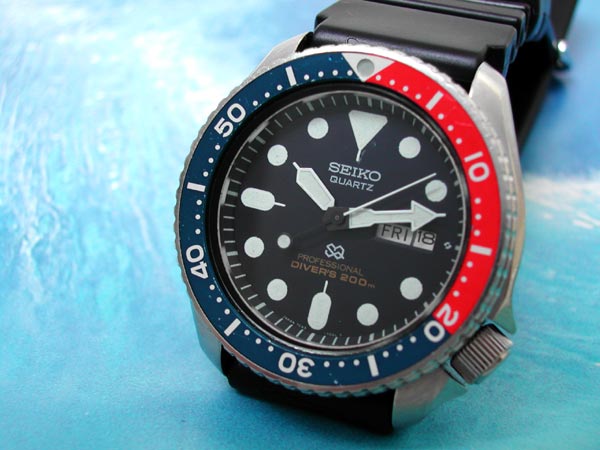
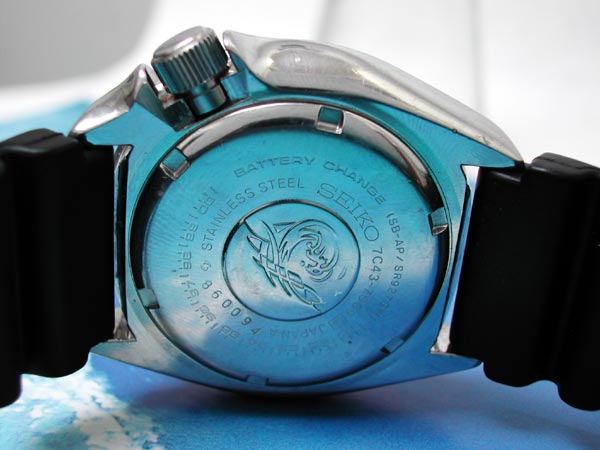
The 7C43 200m quartz diver has the same form factor and appearance as the smaller 6309 and the 7002 automatic divers in circulation in the same period. However, the construction of the 7C43 diver is in the same class as other high-end "Professional" models in that they use a screw-down ring to secure the crystal and the L-shape gasket for protection against helium gas ingress and egress.
Mr. Tokunaga describes these divers as follows: "Although the case structure is a standard type two-piece case (with screw case back) specification, there are 15 new technologies in this case such as; the powerful glass screw ring fixed structure same as 600m with the same glass fixing structure, L shaped glass gasket structure, glass screw ring fixing structure, twin side shield crown structure, special elastic strap made from polyurethane rubber of SEIKO original strap."
There are two variations of the 7C43 diver: a black-bezel version (7C43-7000) and a Pepsi-bezel version (7C43-7009). It seems the only difference is the bezel color.
Credit: Kevin Chan
Credit: Kevin Chan

Credit: Kevin Chan
The 7C43 diver's bezel screw-down construction (left) compared to a 6309 small-case diver's press-fit bezel (right)
More info
- The Tokunaga Watch Museum (English version)
- Mr. Ikuo Tokunaga's Seiko watch site [in Japanese]
- 6215-7000 300m diver, info from the Tokunaga Museum
- 6159-7000 300m diver, info from the Tokunaga Museum
- 6159-7010 600m diver, info from the Tokunaga Museum
- 7549-7000 600m diver, info from the Tokunaga Museum
- 7C46 1000m quart diver, info from the Tokunaga Museum
- 7C43 200m quartz diver, info from the Tokunaga Museum
- Explanation about the merits of mechanical watches and quartz watches.(long)
- Titans of the Deep, by Carlos Perez
- Seiko Professional Diver's Watch New Website (image/link) [Ikuo Tokunaga's site]
- History of the Development of the Seiko Professional Divers Watch
- "End Of Summer (Seiko) Diver's Watch Maintenance"
- Inside the SEIKO 1000 meter Professional Diver
- THE SECRET STORY OF SEIKO'S WORLD-LEADING TECHNOLOGY; VOL.3
- The materials of Seiko 1000m diver's watch (image)
- Explanation about the formula of Q=K(P1-P2)at/lh.
- question about He gas and special gasket
- Technical info about the luminous paints of Seiko (scan)
- The display plate of the rotation bezel (Seiko 1000m diver's)
- The Seiko Prospex Shrouded Divers Review
- "The Seiko 600 meter (m) Professional Quartz Diver's Watch."
- OK Guys, the Big, the Bad, the incredibly HUGE, MARINE MASTER
- Review of 300m Professional Quartz Diver (long)
- Old stuff (in 1992) about Seiko Dive Computer M726 and etc.,(scan)
- Just when a guy thinks he's seen all of Seikos diver watches [a mystery 200M shrouded Professional diver]
- Notice anything different about this 200M Diver? (Cal. 7C43 Professional 200M Quartz Diver)
- Here's another vintage Seiko quartz diver... (Cal. 7C43 Professional 200M Quartz Diver)
- Some follow-up pics of the Professional 200m quartz diver...
Current or re-issued models: