Seiko & Citizen Watch Forum Message Archive
Those "Cheap" Seiko Watches from the 1960's and '70's (essay w/scans)
"Those "Cheap" Seiko Watches from the 1960's and '70's"

Shochiku movie logo. The company made such 1960's classics as the Godzilla movies and the Tora-san films.
Almost all of the Seiko watches from the 1960's and '70's which we consider to have been high quality and "cheap" were actually very expensive items in Japan.
There is a "legend" about the Seiko diver's watches, such as the 6105 and 6309 versions, being discovered by American G.I.s who were either stationed in or passed thru Japan during the Vietnam War Era.
These watches probably seemed cheap to the American soldiers, who were using U.S. Dollars to buy them at the PX or after exchanging their money into Japanese Yen. The reason these watches seemed so cheap was the American economy was so strong at the time. The prices Japanese people were paying for high quality Seikos relative to their monthly incomes, on the other hand, has changed very little from the 1960's to the present.
Large companies in Japan -- from computer makers to banks to department stores -- hire college graduates only once a year. They are called "company freshmen" and all join the company at the same time. They "enter" the company in April and undergo from two weeks to one month of orientation and training before being assigned to different jobs within the organization.

Perhaps similar to the case with the USA in the 1950's, graduation from college by Japanese in the decade of the '60's was hardly as common as it is today and those who did so could expect to earn greater monthly incomes than those without college degrees.
One way Japanese measure the strength of their economy, and the value of items for any given year, is to measure prices against the average monthly salary of a company freshman. In 1968, the average monthly salary of a college graduate entering a Japanese company was approximately 28,000 yen.
That same year Seiko released the 150m 6105A diver's watch. The watch retailed for 14,500 yen, or about half the monthly income of a company freshman.
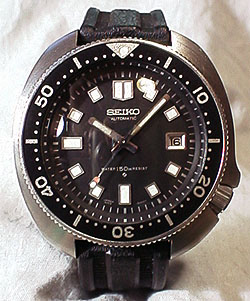
6105A
That same year Seiko released the 6159A caliber 300m Professional diver watch. It retailed for 38,000 yen. This meant the average company freshman had to devote more than one month's salary (which was 28,000 yen) to buy one of these watches.
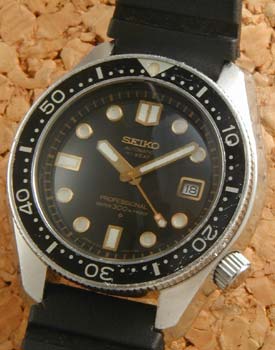
6159A
By 1970 the average company freshman's salary had risen to 32,150 yen per month. That same year, the 6138A caliber Seiko 5 Sports Speedtimer was released. Models sold from between 20,000 to 23,000 yen. The 6138B caliber chronograph retailed for 30,000 yen. Again, this meant the average company freshman had to spend most or nearly all (depending on the model) of one month's salary to buy one of these watches.
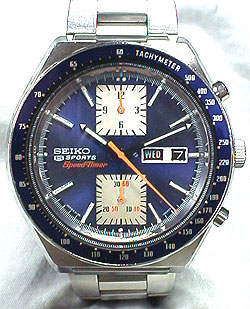
6138A
Now let's look at the current situation.
The average salary of freshmen entering a Japanese company in the year 2002 was 200,464 yen. The current MarineMaster 300m Professional Automatic retails for 250,000 yen, making the price a freshman has to pay for a Seiko 300m professional automatic today similar to what one had to pay in 1968.
(I understand that in the 1960's and '70's, one had to pay retail prices for things in Japan as there were no discount stores. In the 1990's that changed, and currently it is easy to buy a MarineMaster auto in Japan for 20% to 30% off retail, or less than 200,000 yen, making it a cheaper item in relative terms than what a person had to pay for a 300m pro auto in 1968 -- but that is a different issue.)
Catalog image of current MarineMaster 300m Professional
Automatic
Regarding the 6105A diver's watch, it cost about half a freshman's monthly salary in 1968. Using the salaries of today's average company freshman, half of 200,464 yen is 100,232 yen. That is about what the current Seiko 1000m Professional Quartz goes for.
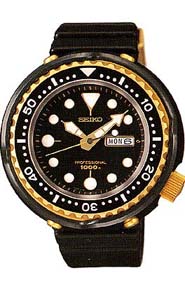
Current model 1000m Professional Quartz. In terms of both quality and price -- very similar to the 6105A.
Considering "re-imported" Seiko 7S26 200m diver automatics can be purchased today in Japan for about 20,000 yen -- it appears the 6105 was about 5 times as expensive in relative terms. Is it any wonder some feel these old 6105 diver watches were better made than the current 7S26 ones?
Current SKX007K made in Singapore and "re-imported" for sale in Japan
I guess I'm trying to make two points with this post.
1) The "cheap" and high quality Seiko watches of the past were actually expensive and high quality watches. The percent of one's monthly salary the Japanese had to pay for watches such as the 150m 6105 diver watch, the 6159 300m professional version, or for a 6138 chronograph are not much different than what they have to pay now for a current Prospex 1000m professional quartz, a MarineMaster 300m professional automatic, or even a FlightMaster chronograph. The 6105, in particular, was not "just a cheap Seiko," and there is a reason why it's quality and appearance stand out even today in rough pieces one can buy on Internet auction sites.
2) When folks comment they "wish Seiko would make cheap and high quality chronographs" like the did in the '70's, they need to realize these watches were not cheap! What they are really wishing is "I wish the American economy was as strong it was then and items imported from abroad could be purchased cheaply using US dollars."
Ryan
Message Thread
- Those "Cheap" Seiko Watches from the 1960's and '70's (essay w/scans) - Ryan - 2002-08-22 18:03:00
- What a great post Ryan - petew - 2002-08-22 18:09:00
- Ryan - Very interesting analysis... (questions) - Wayne Lee - 2002-08-22 18:12:00
- Maybe Katsu can answer question 1 ... regarding question 2 ... - Ryan - 2002-08-22 19:15:00
- The time to changeing.. - katsu - 2002-08-24 00:01:00
- Great Post Ryan... - Rob Backstrom - 2002-08-22 18:29:00
- Thank you. nt - Vince - 2002-08-22 18:33:00
- Thanks Ryan for your unique insights.... - jake359 - 2002-08-22 18:56:00
- The US dollar was worth more then in Japan than it is now. - Mitchtwo - 2002-08-22 20:32:00
- You're right, Mitch (more) - Ryan - 2002-08-22 22:06:00
- Ryan, what's your take on this... - Tolley - 2002-08-22 19:54:00
- Your comments are spot on, Tolley (more) - Ryan - 2002-08-22 20:54:00
- Thanks Ryan. nt - Carlos - 2002-08-22 19:56:00
- Very nice....a cut above! - ASH - 2002-08-22 20:22:00
- Thanks Ryan for such wonderful horological economics!! nt - Brandon Aybar - 2002-08-22 20:37:00
- Really enjoy reading it. Domo Domo...Ryan-san..!(NT) - Daniel Choh - 2002-08-22 20:56:00
- Thanks Ryan for a very informative and scholarly post. nt - hawkeye - 2002-08-22 21:01:00
- Ryan, what a fantastic "sanity check" >>> - Bob A (SD) - 2002-08-22 21:37:00
- Great story, Bob A ... - Ryan - 2002-08-22 21:55:00
- Great Post Ryan, thanks.......................................NT - Manoj - 2002-08-22 22:32:00
- Wonderful post! Extremely informative as usual. (nt) - Chris - 2002-08-22 23:55:00
- Thanks for this essay and for all the others that you >> - John W - 2002-08-23 04:26:00
- Thanks to everyone for your kind words (more) - Ryan - 2002-08-23 04:32:00
- great stuff! - frankie - 2002-08-23 16:27:00
- Many thanks Ryan. Another great essay. nt - Barney - 2002-08-23 07:04:00
- Ryan, outstanding discussion. Thanks for your analysis. nt - Rob - 2002-08-23 07:52:00
- Once again a very clear insiteful lesson from the Master Teacher - Del Cline - 2002-08-23 13:13:00
- Some comments on Japan Yahoo Auctions - Ryan - 2002-08-24 15:56:00
- It makes so much sense. THX - regjo - 2004-08-16 11:58:00